

Cart
0
ROOTS & THREADS
Notes from the Founder
Selam lovely people,
Welcome to the first post in Roots & Threads: Notes from the Founder, a monthly series where I answer the questions you ask me most, whether at a pop-up, across the counter, or in a message about a bag strap.
Every time I tell someone that everything we make is handmade in Ethiopia, their face changes. Before they ask about the weaving or the leather, before they ask how long a bag takes, they ask me about the food. What’s my favorite Ethiopian restaurant? Have I tried this dish or that one? And then, almost always, they tell me about their own: the little place they found years ago, the birthday dinner where they ate with their hands for the first time, the friend who taught them how to tear the injera just right.
I love this. It means Ethiopian food already lives somewhere warm in people’s memories, and I get to add to it. I always describe Ethiopian Food as getting a hug from the inside.
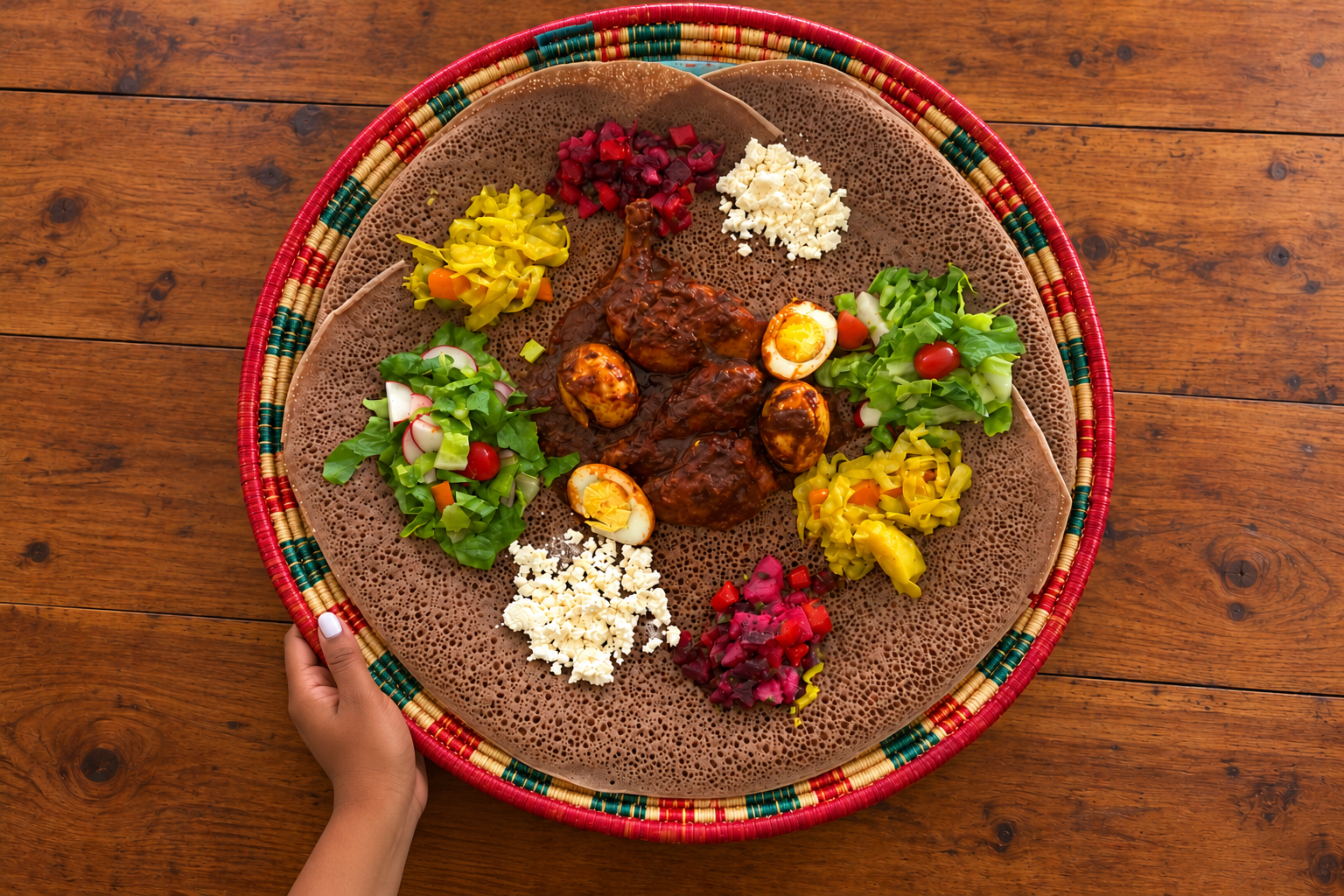
So here is my answer, once and for all. Doro Wat. Hands down.
When I’m back in Ethiopia, I eat it every single day, and some days at every meal. If you’ve only had it in a restaurant, you may not know how much patience is in it. The onions go in first and cook down slowly, for far longer than feels reasonable, until they melt into the base of the sauce. Then comes the berbere, that deep red spice blend with its slow-building heat, and the niter kibbeh, a spiced clarified butter that makes the whole kitchen smell like something you want to walk toward. The chicken simmers in all of it until it falls apart at the touch, and a hard-boiled egg goes in near the end, soaking up the color.
It arrives on injera, the soft, tangy, spongy flatbread made from teff, and the injera is part of the dish. It catches everything. You tear a piece, scoop, and eat with your right hand. If someone at the table loves you, or is trying to make you feel welcome, they might feed you a bite themselves. It’s called a gursha.
Doro Wat is traditionally a dish for holidays and celebrations, the thing you make when the people you care about are gathered. I find it a little wonderful that I get to have it on an ordinary Tuesday morning.
If you’re trying Ethiopian food for the first time, Doro Wat is a feast. Order it with injera, ask for a side of greens or ibe (a mild, fresh cheese) to share, and don’t worry about doing it perfectly. Nobody at an Ethiopian table is grading your technique. The point is to eat together, slowly, from the same plate.
It’s the same spirit I think about when I think about our pieces. Things made slowly, by hand, by people who know exactly what they’re doing, and meant to be shared and kept. Our partners in Ethiopia are women-owned businesses that pay fair wages, and the skill in their hands is the same skill that goes into a pot that’s been tended all afternoon. You can taste care, and you can wear it too.
Now it’s your turn. What’s your favorite Ethiopian dish, or the restaurant you’d send me to next? Tell me in the comments or reply to my newsletter. I read every one, and I’d love to hear your story.
If this made you hungry for more of the story, come meet the pieces. Every ShopYego bag, jumpsuit, and cardi is designed in LA and handcrafted in Addis with women-owned businesses that pay fair wages, made slowly, the way good things are. Explore our handcrafted leather bags and find the one you'll keep for years.
See you next month, Yego.
